In choosingTFT LCDWhen designing a display screen, size, resolution, and brightness are the most critical parameters. As more and more electronic products are used in outdoor environments, the visibility of TFT displays under strong light and direct sunlight becomes particularly important. Screens with normal brightness often exhibit problems such as washed-out images and illegible text when used outdoors.
With over 13 years of experience in LCD display R&D and mass production, Hongcai Technology has summarized some professional knowledge and practical solutions for improving display brightness. Different application scenarios have vastly different brightness requirements. For example, indoor devices such as home appliances, game consoles, and handheld terminals typically use displays with a brightness of approximately 350 nits.LCDA standard display screen provides a clear and comfortable visual experience. However, outdoor applications, such as logistics PDAs, access control facial recognition devices, and outdoor instruments, require high-brightness screens with a brightness of over 1000 nits to ensure clear display even in sunlight.
In outdoor applications or under strong light conditions, various optical and structural optimization methods are needed to increase screen brightness in order to improve the visibility of LCD displays. Based on Hongcai Technology's actual mass production experience in customer projects, the following are some commonly used brightness enhancement solutions and their effects for reference:
1. Apply a brightness enhancement polarizing film (DBEF).
Replacing the ordinary polarizer on the lower surface of the TFT glass with a brightness-enhancing polarizer can effectively increase brightness by approximately 30% to 40%. This is one of the most common, easiest, and most effective brightness enhancement methods currently available, and it offers good value for money at present. For example, a 2.4-inch display using this solution will have a brightness of 350 cd/m² (typical value) under normal backlight, which can be increased to 460 cd/m² after replacing it with a brightness-enhancing polarizer.
2. High-reflectivity backlight material (3M ESR)
Using a 3M ESR reflective film can improve the backlight reflection efficiency, increasing brightness by approximately 10% to 15%. Alternatively, a Mitsubishi white reflector can be used, increasing brightness by approximately 2% to 8%. For example, a 2.4-inch display using this solution will have a brightness of 350 cd/m² (typical value) under normal backlight conditions, but after using the 3M ESR reflective film, the brightness can reach 380 cd/m².
3. High-brightness enhancement film for backlighting
Using a brightness enhancement film with higher light transmittance can further increase brightness by approximately 2% to 3%. For example, a 2.4-inch display using this solution will have a brightness of 350 cd/m² (typical value) under normal backlight, and with a brightness enhancement film with higher light transmittance, the brightness can reach 360 cd/m².
4. Increase the number of LEDs
Depending on the size of the light guide plate, the number of LEDs can be increased based on the original LEDs, improving brightness by approximately 5%. For example, a 2.4-inch display using this solution achieves 350 cd/m² (typical value) with 4 LEDs under normal backlighting; increasing to 6 LEDs can achieve 450 cd/m².
5. Replace the high-brightness LED components.
Using high-brightness LEDs can increase overall brightness by 4% to 8%, although the color may have a slightly yellowish tint and not be a perfectly pure white. For example, a 2.4-inch display using this solution will have a brightness of 350 cd/m² (typical value) under normal backlighting, but with high-brightness LEDs, the brightness can reach 390 cd/m².
6. Employs dual-chip LED components
Using dual-chip high-brightness LED components doubles the LED current, and the backlight temperature also rises accordingly. At room temperature (40 degrees Celsius), brightness can be significantly improved, with an increase of up to approximately 40%. For example, a 2.4-inch display using this solution will have a brightness of 350 cd/m² (typical value) under normal backlighting, but with dual-chip LEDs, the brightness can reach 700 cd/m².
7. Customized dual-row backlight structure
When the target brightness needs to reach over 1000 nits, a custom-designed dual-row LED backlight module is used to fundamentally improve luminous efficiency and uniformity. For example, a 2.4-inch display using this solution achieves 350 cd/m² (typical value) under normal backlighting, but with dual-chip LEDs, the brightness can reach 1000 cd/m². This type of TFT display will increase the size of the backlight. Generally, combining methods 1-6 above can also achieve 1000 cd/m².
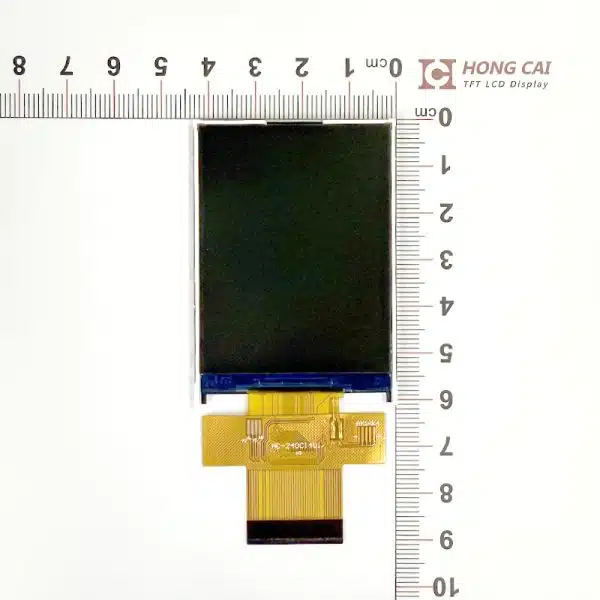
2.4-inch LCD display with 1000 nits brightness
Outdoor high brightness TFT display
- Size: 2.4
- Resolution: 240×320 dots
- Viewing angle: 12 O'clock
- Interface type: MCU 8BIT/16BIT
- Driver chip: ST7789V
- Touch method: TBD
- Backlight brightness: 1000 cd/m²
- Dimensions: 42.72 (W) * 60.26 (H) * 2.30 (T)
Generally, by reasonably combining the above 1 to 6 brightness enhancement methods, the brightness of the display screen can reach a level of about 1000 cd/m² (nits), which meets the usage requirements of most outdoor display screen display scenarios.